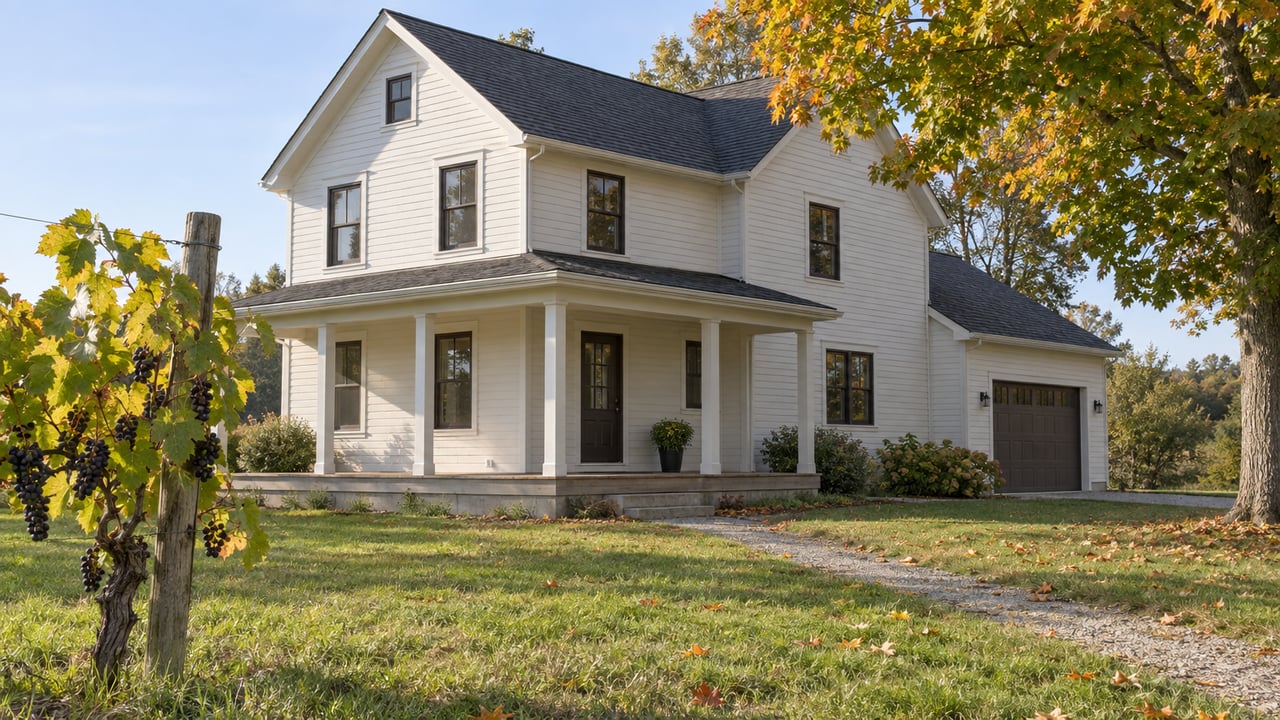
A five-acre parcel off Doty Road, half a mile from Debonné Vineyards, lists for a price that looks almost too good against anything closer to the lake. The listing photos show a mowed front acre, a farmhouse, and rows of vines stretching into the back four. What the photos do not show is that those back four acres are very likely enrolled in Ohio's Current Agricultural Use Value program, a property tax arrangement that has kept the seller's tax bill low for years and that quietly transfers its obligations to whoever buys the land next.
That is the part buyers miss. The tax break is not the seller's problem to solve before closing. It is the new owner's problem to manage after closing, and it stays that way until the land either keeps farming or someone pays back what the program saved.
What the Auditor's Office Actually Recoups
CAUV lets Lake County tax farmland based on its agricultural value instead of what it would fetch on the open market, and the gap between those two numbers is often substantial for anything zoned residential or adjacent to development. The Lake County Auditor's office is direct about what happens when that gap closes: land converted from agricultural use is subject to a recoupment charge equal to the tax savings on the converted land during the three years immediately preceding the conversion. In plain terms, if you buy vineyard-adjacent land taxed at farm rates and then build a house, put in a driveway across the cultivated section, or otherwise stop farming it, the county goes back three years and bills you the difference between what was paid and what would have been paid at full market value.
That bill does not show up at the closing table. Nobody prorates it into the purchase price the way property taxes get split between buyer and seller. It shows up on a future tax bill, sometimes years after the sale, whenever the land use actually changes. A law firm that handles Ohio farmland transactions puts it plainly: if you purchase property that qualifies for CAUV, build a home on it, and the land no longer qualifies, recoupment is triggered, and that risk is worth putting in writing in the purchase agreement before you close, not after.
The program itself is not obscure. It has existed in Ohio since the 1970s and requires renewal every year, with applications due by the first Monday in March. Miss that date, or change how the land is used, and the county treats the parcel as converted. Lake County's own CAUV department, based out of the Auditor's office in Painesville, handles the paperwork and the recoupment calculations directly, and the office is the right first call for anyone trying to figure out what is currently enrolled on a specific parcel before writing an offer.
Why So Much of Madison Carries This Status
This is not a quirk that shows up on a handful of unlucky lots. Madison sits inside the Grand River Valley American Viticultural Area, which runs roughly two miles inland from the mouth of the Grand River at Fairport Harbor to Route 45 in Saybrook, staying within about fourteen miles of the Lake Erie shoreline the whole way. That strip of land benefits from thermal protection off the lake that moderates temperature swings and gives grapes a longer growing window than farmland just a few miles further south, and generations of growers have built their operations around it.
Debonné Vineyards, doing business as Chalet Debonné, is the anchor of that geography and now Ohio's largest estate winery, tending more than 175 acres of vines on Doty Road. The Debevc family has farmed that property since Anton Debevc settled there in 1916, and the state recognized it with an official Century Farm designation in 2016. That is not a marketing detail. It is a hundred years of continuous agricultural use sitting on land that, by definition, has almost certainly been enrolled in some version of a farm tax program for as long as the program has existed, and the smaller parcels that ring that core acreage tend to inherit the same status when they were carved off a working farm.
That density of enrolled land is exactly why the CAUV question comes up more often here than in a typical Lake County subdivision. Buyers shopping in Madison are frequently shopping adjacent to working agriculture, not just near open space that happens to look rural.
The Woodland Wrinkle
Not every acre on a rural Madison listing sheet is cropland, and the county treats wooded ground differently depending on size. Under Lake County's guidelines, noncommercial woodland qualifies for CAUV only if it sits contiguous to at least ten acres of cropland or pasture, and any wooded section larger than five acres needs a formal Woodland Management Plan to qualify as commercial timber. A wooded pocket under five acres does not qualify at all, regardless of how it is used.
This matters because a buyer eyeing a wooded back lot for a future outbuilding, a pond, or simply privacy needs to know whether that specific acreage is carrying CAUV status or sitting outside the program entirely. A five-acre patch of trees can be treated completely differently from a six-acre one under the same set of rules, and the only way to know for certain is to check the parcel's enrollment directly with the Auditor's office rather than guess from the listing description.
The Clock Nobody Mentions at the Closing Table
The detail that catches people off guard is not that CAUV exists. Most buyers who look at rural land eventually hear the term. What surprises people is when the county actually checks.
CAUV status is not verified once at closing and then forgotten. It is renewed every single year, with the application window closing the first Monday in March, and the recoupment trigger is tied to whenever the land use changes, not to when the deed changes hands. That means a buyer can close on a parcel in good standing, wait two or three years, then decide to build a second structure or clear a cultivated section for a yard, and get hit with a recoupment bill years into ownership with no connection to the purchase transaction at all. The three-year lookback period the county uses to calculate the charge runs from the year the conversion happens, so the exposure follows the land use decision, not the sale date.
For anyone buying rural acreage near Madison's wine country with plans to eventually build, subdivide, or simply landscape differently than the current owner, that timing gap is worth understanding before signing anything, not after breaking ground.
Three Questions Worth Asking Before You Sign
- Is the parcel currently enrolled in CAUV, and if so, which portions of it, since mixed-use parcels can have some acreage enrolled and some not.
- What would the recoupment charge look like if the land were converted to residential use today, and has the seller been notified of any pending changes to that status.
- Has the seller agreed in writing to disclose or address CAUV exposure in the purchase agreement, rather than leaving it as an assumption on either side.
The Lake County Auditor's office can confirm current enrollment status on a specific parcel, and that confirmation is worth getting before an offer goes in, not during due diligence when timelines are already tight.
None of this makes land near Madison's vineyards a bad buy. The area's agricultural roots are part of what makes it worth living in, and a fair number of buyers are drawn to Madison precisely because that working landscape is still intact. It just means the tax bill on a rural parcel here is doing something different than the tax bill on a standard suburban lot, and the difference is worth understanding in dollars and timing before the land is yours.
If you are looking at acreage in Madison Township, whether it is a former farm parcel, a wooded lot near the wineries, or something in between, Beth Kitchen can help you sort out what is actually enrolled on a given property and what that means for your plans before you write an offer.